
Polymarket vs Kalshi (2026): Fees, Volume, and Which Is Bigger
Polymarket vs Kalshi is the defining rivalry in prediction markets, and in 2026 the two platforms are more different than their similar-looking markets suggest. One is a crypto-native exchange settling onchain, the other a CFTC-regulated US exchange settling in dollars. They disagree on fees, access, custody, and sometimes on the price of the exact same event. Costs differ again once you look across the whole category, compared in prediction market fees.
This comparison covers what actually separates them: how big each one is, what trading costs, who is allowed to use which, how their sports markets differ, and what developers get from each API. Where the two disagree on price, that gap is itself tradable, and we cover that too. Access depends heavily on where you are, as prediction markets in the Netherlands shows.
Key Takeaways
- Polymarket is the global volume leader with crypto-native, self-custodial trading on Polygon; Kalshi is the leading CFTC-regulated US exchange with dollar accounts and the institutional feature set.
- The real decision is access and custody, not features: Kalshi means KYC and USD; Polymarket means a wallet and pUSD, with a separate regulated Polymarket US for American users.
- Because both list the same major events at independently set prices, the most interesting relationship between them is the price gap, which is where cross-venue arbitrage lives.
Polymarket vs Kalshi at a Glance
| Polymarket | Kalshi | |
|---|---|---|
| What it is | Crypto-native prediction market, CLOB with onchain settlement (Polygon) | CFTC-regulated US event-contract exchange |
| Money in | pUSD (USDC-backed) in your own wallet | US dollars in an exchange account |
| Custody | Self-custody; orders signed by your key | Exchange holds funds, like a brokerage |
| Sign-up | Wallet connection; separate KYC'd Polymarket US for Americans | Full KYC (ID, SSN for US users) |
| Prices | 0 to 1 decimals | Dollar prices with subpenny precision (legacy cents display) |
| Fees | Maker orders free; taker fees on some categories | Per-trade fees that scale with contract price |
| API | Free reads incl. WebSocket, no key needed | Public REST reads; order book, WebSocket and trading need keys |
| Regulator | Offshore for the global exchange; Polymarket US is CFTC-regulated | CFTC |
The Core Difference: Onchain vs Regulated
Every other difference flows from one choice each company made. Polymarket built on crypto rails: markets settle onchain, collateral is a dollar-backed token in your own wallet, and trading is permissionless in most of the world. Kalshi built inside the US regulatory system: it is a CFTC-designated exchange where contracts clear in actual dollars and every account is identity-verified. Availability varies by jurisdiction, and the options in Hong Kong are narrower than the headline names suggest.
Neither approach is simply better. Polymarket's rails give it global reach, self-custody, and the deepest liquidity in the space. Kalshi's rails give it legal clarity for US residents, institutional-grade infrastructure including a FIX API, and dollar settlement with no crypto anywhere in the flow. Your passport and your comfort with wallets decide most of this choice before features ever enter the picture.
Which Is Bigger: Polymarket or Kalshi?
By global trading volume, Polymarket is still widely cited at the time of writing as the largest prediction market in the world, and its headline events, elections above all, produce volume no other venue matches. Kalshi is the largest regulated venue in the US, and it has grown aggressively through 2025 and 2026, particularly in sports and economic contracts where its legal status lets it market to mainstream American users. UK readers have a different shortlist again, set out in the top prediction markets in the UK.
The honest answer is that "bigger" depends on the category and the month. Election season inflates Polymarket; US sports seasons inflate Kalshi. What matters for a trader is depth in the specific market you want to trade, and that you check on the order book, not the headline. It is entirely normal for the same event to be deep on one platform and thin on the other.
Polymarket Fees vs Kalshi Fees: What Trading Actually Costs
Polymarket historically charged no trading fees at all. That ended in early 2026, when taker fees rolled out across most categories between January and March. Makers still trade free and can earn rebates on fee-enabled categories. The CLOB V2 upgrade in late April changed how those fees are calculated, not whether they exist, which is a distinction a lot of older write-ups get wrong. The standard app flow runs gasless through a relayer, so Polygon gas is a cost only for API and bot traders signing from their own wallets, plus the transfers that move money on and off the chain.
Kalshi publishes an actual formula, which makes it the easier side to pin down: the taker fee is 0.07 × contracts × price × (1 − price), rounded up to the next cent per order. That peaks at 1.75¢ per contract on a 50-cent market and shrinks toward zero at the extremes, so a contract at 5¢ or 95¢ costs very little to trade. Makers pay a quarter of that rate, and only on markets Kalshi designates as maker-fee markets; many carry no maker fee at all. Settlement costs nothing, ACH is free both directions, and there is no membership, inactivity or API charge. The S&P 500 and Nasdaq-100 series run at roughly half the standard coefficient.
Which venue is cheaper depends on how you trade, not on which one markets itself as cheap. For resting limit orders Polymarket usually wins, because free is hard to beat. For instant fills it turns on your price level and the category's taker rate, and the margin is often thin enough to decide a trade outright: a two-cent edge can survive one venue's fees and die on the other's. Kalshi's per-order round-up quietly punishes very small orders, since a single contract pays a full cent no matter how cheap it was. We deliberately don't reprint Polymarket's per-category rates here, because they have moved repeatedly since launch and the official fee page is the only source that stays current. Our deeper breakdowns are the Polymarket fees guide and the Kalshi fees guide.
Sports: The New Battleground
Sports has become the most contested category between the two. Kalshi's regulated status lets it offer sports event contracts across the US, positioning itself as an alternative to sportsbooks with exchange-style pricing. Polymarket lists major sports globally with deep books on marquee events. If sports is your main interest, compare the specific leagues you follow: coverage differs, and so do prices, often by enough to matter.
It is also no longer a two-horse race. Robinhood has pushed event contracts to a mainstream audience through KalshiEX, ForecastEx and Rothera, the exchange it co-owns with Susquehanna, and DraftKings launched its own exchange, DKeX, on 26 June 2026 using the CFTC licence it picked up with Railbird. More venues listing the same games means more pricing disagreements, which is good news if you shop across books and bad news if you assume your platform's number is the market's number. We compare the exchange model against traditional books in prediction markets vs sports betting.
Who Can Actually Use Which
For US residents the historical answer was "Kalshi, and only Kalshi." That stopped being true on 12 May 2026, when Polymarket US dropped its waitlist and opened to the public. Polymarket US is a genuinely separate CFTC-regulated exchange, built on the QCX licence Polymarket acquired in July 2025, with its own accounts, full KYC, dollar rails and its own fee schedule at docs.polymarket.us. It is not the global site with a US flag on it, and conflating the two is the single most common mistake in coverage of this rivalry.
Neither venue is available everywhere in the US, and the map is still being drawn in court. Minnesota's criminal ban was blocked by a federal judge on 28 July 2026, days before it was due to take effect; Tennessee and Connecticut have issued cease-and-desist orders; and the CFTC has sued several states over their authority to block federally regulated event contracts. On the other side of that fight, the Third Circuit affirmed Kalshi's injunction against New Jersey in April 2026. Expect this list to keep changing.
Outside the US the picture inverts. Polymarket's global exchange is the default, but its restricted-jurisdiction list has grown past 30 countries and now includes the UK and Singapore, while Polymarket's own geoblock documentation lists Ontario, Alberta, British Columbia and Quebec as close-only, meaning you can exit positions but not open new ones. Kalshi, meanwhile, is no longer strictly a US venue: it began international expansion in 2026, starting with Brazil. Either way, expect identity verification anywhere a regulator is involved, and check each platform's current terms for your own country, because eligibility rules move faster than blog posts. This is general information rather than legal, tax or investment advice.
For Developers: Two Very Different APIs
Both platforms offer serious APIs with free market data, and they differ the same way the exchanges do. Polymarket's API is open to the point of anonymity: prices, order books, price history, and even the streaming WebSocket market channel work with no key and no account at all, and trading is authorised by wallet signature rather than by a login. Kalshi's API is account-shaped. Plenty of REST market data is public, but the order book endpoint requires signed requests, the WebSocket connection requires authentication even for channels carrying public data, and everything that touches an order obviously does too. What you get in exchange is candlestick history, a demo environment at demo.kalshi.co, official Python and TypeScript SDKs, and FIX connectivity no other venue in this space offers.
The rate-limit models differ too. Polymarket's read access is effectively open; Kalshi runs a token-bucket system with separate read and write budgets across seven tiers, where the first upgrade to Advanced is a free self-serve call and higher tiers are earned from trailing 30-day volume. Getting rate-limited returns a 429 and carries no penalty beyond the rejected request, so it is a throughput ceiling rather than a punishment.
We cover both in depth: the Polymarket API guide and the Kalshi API guide walk through endpoints, auth, SDKs, and the 2026 changes that broke older tutorials.
Kalshi vs Polymarket Arbitrage Opportunities in 2026
Because both platforms list the same major events and price them with independent order books, Polymarket and Kalshi routinely disagree by a few cents, and occasionally by much more. That disagreement is where cross-venue arbitrage opportunities come from, and it is the main reason experienced traders keep accounts on both. Here is the routine kind, side by side on one screen:
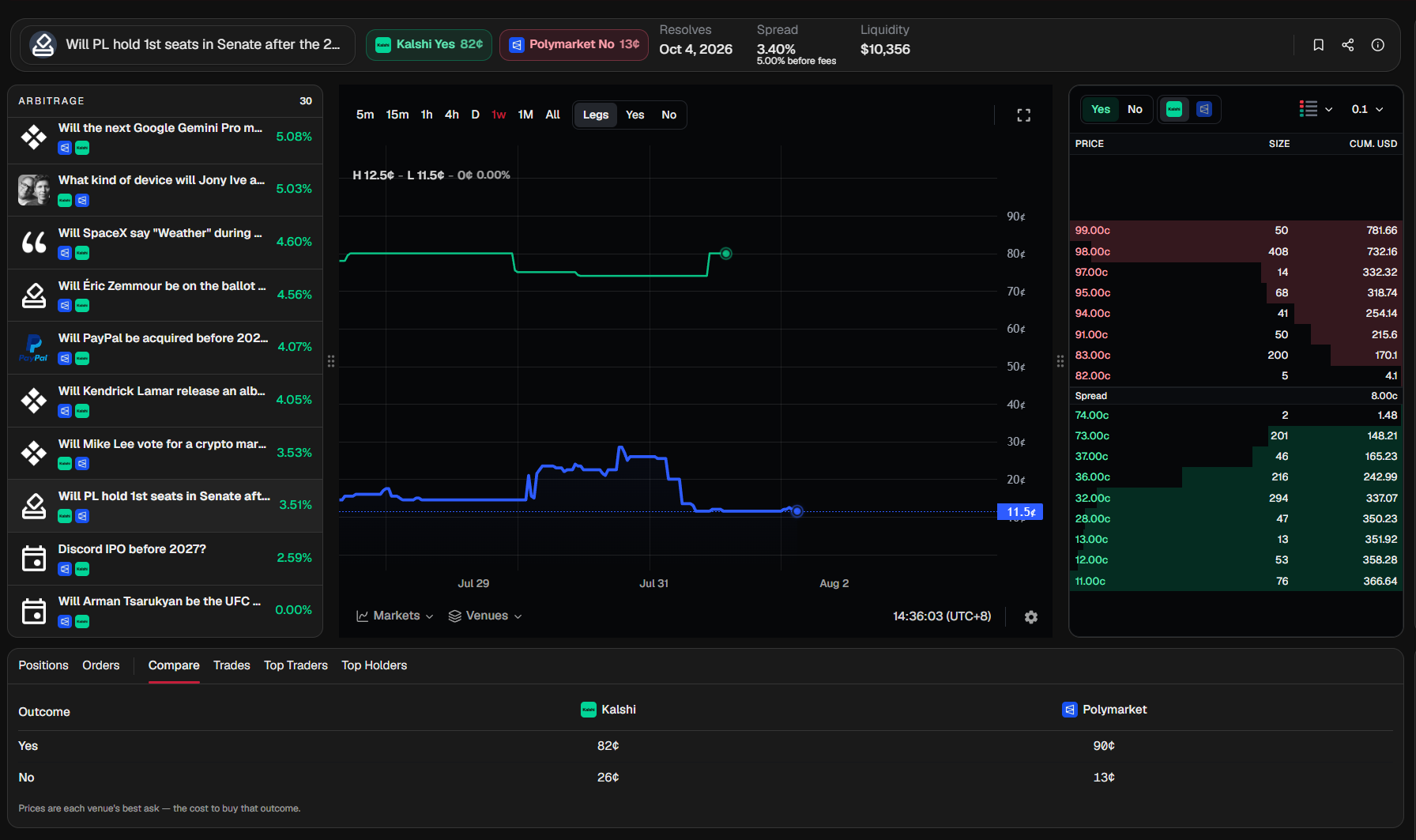
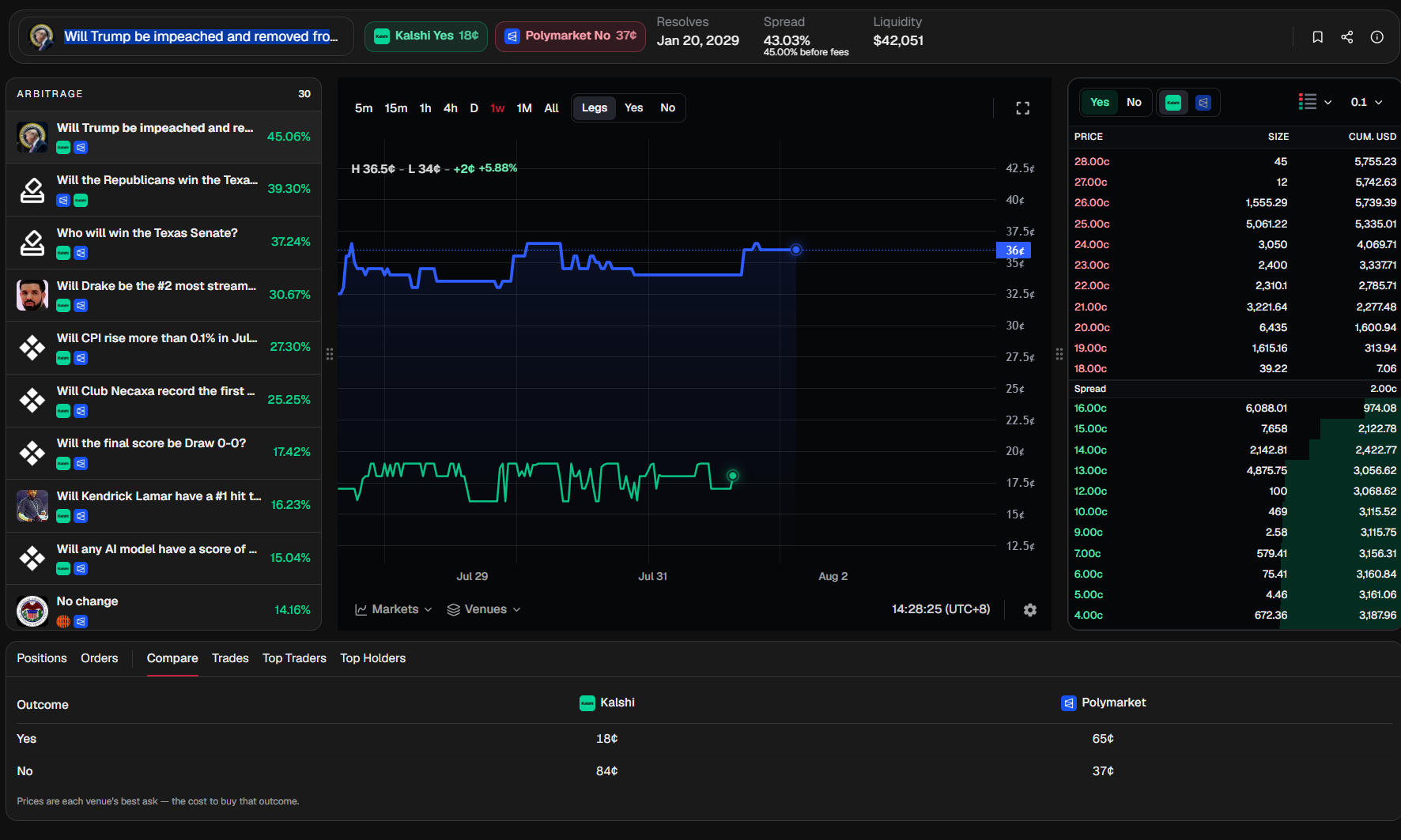
That kind of disagreement is tradable in principle: buy YES on the cheaper platform and NO on the other, and if both legs together cost less than the $1.00 the pair pays out, the spread is yours whichever way the event resolves. The catch is that the quoted gap is not the realised one. Fees on both legs, the spread you actually cross, slippage if the book is thin, the capital parked on two venues until settlement, and the risk that one leg fills while the other moves all eat into it, which is why a gap that looks free on screen often isn't by the time both legs are on. And the bigger the gap, the more suspicious you should be:
The mechanics, the risks, and the trap of near-identical markets that resolve differently are covered in our arbitrage guide. And if you want to watch the two platforms' prices side by side on the same screen, that comparison view is exactly what our own terminal, Predictefy, was built for.
Frequently Asked Questions
Is Polymarket bigger than Kalshi?
Yes, globally. Polymarket is still the volume leader at the time of writing, driven by its election and headline-event markets. Kalshi is the largest regulated US venue and leads in categories like US sports and economic data. Depth varies by market and by month, so check the specific order book you plan to trade.
Which has lower fees, Polymarket or Kalshi?
It depends on how you trade. For resting limit orders Polymarket is usually cheaper, because makers trade free and can earn rebates. Kalshi's taker fee is 0.07 times contracts times price times one minus price, rounded up to the next cent per order. It peaks at 1.75 cents per contract at 50 cents. For instant fills, run both schedules.
Can Americans use Polymarket?
Yes, since 12 May 2026, when Polymarket US removed its waitlist. That is a separate CFTC-regulated exchange with its own KYC, dollar accounts and fee schedule, not the global site. Availability varies by state. Minnesota's criminal ban was blocked by a federal judge on 28 July 2026, and other states have issued cease-and-desist orders.
Are there arbitrage opportunities between Kalshi and Polymarket?
Yes, price gaps appear constantly, because the two have different traders and independent order books. Whether a gap is worth trading is a separate question. Fees on both legs, the spread you cross, slippage and capital tied up until settlement all shrink it. Large persistent gaps usually mean different resolution criteria, so read both rulebooks first.
How does Kalshi compare to PredictIt?
Kalshi is bigger in scope. It is a CFTC-designated contract market listing thousands of markets across politics, economics, sports and weather, with an API and institutional connectivity. PredictIt is a much smaller political-only venue with capped position sizes and a contested legal history. It was still operating at the time of writing. Check its site before depositing. PredictIt is the other comparison people reach for, covered in Kalshi vs PredictIt.
Conclusion: Which Should You Use?
Pick Kalshi if you are a US resident who wants a regulated, dollar-denominated exchange, if you need institutional connectivity, or if US sports and economic contracts are your focus. Pick Polymarket if you want the deepest global liquidity, self-custody, and the most open data access in the space, or Polymarket US if you are American and want its market list under CFTC regulation.
The advanced answer is both: the platforms disagree often enough that the pair is worth more than either alone. For the full landscape beyond these two, see our ranking of the 7 best prediction market APIs and SDKs in 2026.