
Risk-Free Arbitrage in Prediction Markets in 2026
Risk-free arbitrage in prediction markets is the practice of buying both sides of the same event on different venues so that the payoff is the same whichever outcome lands. In 2026 the same real-world event can trade on Polymarket, Kalshi, Opinion, Limitless, and SX Bet at once, each venue pricing it slightly differently. When those prices disagree by more than the cost of trading them, the gap can be captured with no exposure to the outcome itself. The gaps are real and they recur. What the screenshots leave out is that only a small minority of events are listed on more than one venue at all, and that most of the gaps which do appear are harder to capture than the math suggests.
This is the complete guide: the price math, a worked example with real numbers, the three types of opportunity, a step-by-step process for finding opportunities yourself, and the operational risks that decide whether "risk-free" holds up in practice. Venue details below were checked against exchange documentation on 9 August 2026; fee schedules and country restrictions move quickly, so confirm both on the official pages before you size anything. One honesty note up front: the payoff lock is mathematically real, but it only survives contact with fees, rulebooks, and execution if you manage the operational details covered below. Traders who skip that part are not arbitraging, they are gambling with extra steps.
Key Takeaways
- Every prediction market price is an implied probability wearing a different costume: 0.65 on Polymarket, 62 cents on Kalshi, and 1.56 decimal odds on a sports exchange can all describe the same event. Arbitrage starts by converting everything to one probability scale.
- The core trade is a synthetic lock: buy YES on the cheap venue and NO on the expensive one. If both legs together cost less than $1.00 of guaranteed payout after fees, the profit is locked no matter the outcome.
- The math is the easy part. Market matching, resolution risk, capital spread across chains, and execution speed are what actually decide whether an arb is capturable.
What Is Prediction Market Arbitrage?
A prediction market contract pays a fixed amount, usually $1.00, if an event happens and nothing if it does not. The price you pay for that contract is the market's implied probability. A YES share trading at 0.62 means the market collectively believes the event has roughly a 62 percent chance of happening.
The complication is that venues express this probability in different formats. Polymarket and Opinion quote decimals between 0 and 1. Kalshi quotes cents from 1 to 99, where a matched YES and NO pair always sums to $1.00. SX Bet, built for sports, quotes decimal odds on a fixed ladder. Underneath the formatting, all of them are saying the same kind of thing: here is what this crowd believes.
Arbitrage exists because these crowds are different. Polymarket's crypto-native traders, Kalshi's retail and institutional flow, and SX Bet's sports bettors do not always agree, and they do not update at the same speed. When news breaks, one venue reprices in seconds while another lags for minutes. That lag is the opportunity. A January 2026 preprint covering more than 100,000 events across ten venues (Gebele and Matthes, arXiv:2601.01706) put the average cross-venue deviation on equivalent markets at 2 to 4 percent, and found only around 6 percent of events listed concurrently on more than one venue. The disagreement is common. The second leg is the scarce part.
A Worked Example: Kalshi vs Polymarket
Suppose a Fed rate-cut market trades at 62 cents on Kalshi while the equivalent Polymarket market shows YES at 0.65. The venues disagree by three points of implied probability. Here is the lock:
| Leg | Venue | Side | Price | Pays if cut | Pays if no cut |
|---|---|---|---|---|---|
| 1 | Kalshi | Buy YES | $0.62 | $1.00 | $0.00 |
| 2 | Polymarket | Buy NO | $0.35 | $0.00 | $1.00 |
| Total cost | $0.97 | $1.00 | $1.00 | ||
Whatever the Fed does, exactly one leg pays $1.00. You spent $0.97 to guarantee $1.00, a gross return of about 3.1 percent with zero directional exposure. Scale that across size and repeat it across markets, and you have the theory of cross-venue arbitrage.
Now subtract reality. Both venues charge takers, and both price the fee the same way: a coefficient times contracts times price times one minus price, which peaks at 50 cents and shrinks toward the extremes. Kalshi's standard coefficient is 0.07, rounded up to the next cent per order. Polymarket's global exchange sets its coefficient by category, 0.07 in crypto down to nothing in geopolitics, while Polymarket US charges a flat 0.06 across the board. Makers are never charged on either Polymarket exchange and pay nothing on most Kalshi series, though Kalshi does levy a maker fee on designated ones. Your capital also has to be sitting on both venues already, in dollars on Kalshi and in pUSD, the 1:1 USDC-backed token Polymarket now uses as collateral, on the other side.
Run those numbers against the example and the edge mostly disappears. The Kalshi leg at $0.62 costs 0.07 x 0.62 x 0.38, about 1.65 cents per contract. The Polymarket leg at $0.35 costs between roughly 0.91 and 1.14 cents depending on which category the market is filed under. That leaves somewhere near 0.2 to 0.4 cents of the original 3, so the 3.1 percent gross edge lands between roughly a fifth and a half of one percent net. Price the same trade through Polymarket US, where the taker coefficient is a flat 0.06, and the second leg costs about 1.37 cents, which is enough to erase the gap entirely. Coefficients and categories both move, so check the numbers against our Kalshi fee breakdown, the Polymarket one, and each exchange's own published schedule before trusting a spread. A slow second leg turns what is left negative.
What Risk-Free Arbitrage in Prediction Markets Actually Means
Risk-free arbitrage in prediction markets means one specific thing: the profit is locked in regardless of which outcome happens. In the example above, you hold YES on one venue and NO on the other, so exactly one leg pays $1.00 no matter what the Fed does. There is no scenario where the event goes against you, because you own both sides of it. That is what separates true arbitrage from betting: the outcome of the event is irrelevant to your profit.
What risk-free does not mean is that nothing can go wrong. The outcome risk is eliminated; the operational risks remain, and they are the entire second half of this guide. Fees can eat the spread. The two markets can turn out to resolve on different criteria, which quietly converts your lock into a directional bet. Your capital is committed until settlement, which on long-dated markets can mean months or years. So the honest definition is: risk-free with respect to the outcome, not risk-free with respect to execution. Traders who internalize that distinction capture spreads; traders who hear "risk-free" and stop reading donate money to the ones who kept reading.
The Three Types of Opportunity
Cross-venue arbitrage is the example above: the same event, two venues, opposite legs. It is the purest form and the hardest to execute, because it requires matched markets and capital on multiple platforms.
Box and spread arbitrage happens inside a single venue. In a multi-outcome market, the prices of all outcomes should sum to $1.00. When enough traders pile into one outcome, the set can drift below that, and buying every outcome locks a profit with no second venue involved. Venues with grouped outcome structures, like Polymarket and Limitless with their NegRisk markets, are where these appear.
Positive expected value, or +EV, betting is often marketed as arbitrage but is not. A +EV play means the price differs from what your model believes the true probability is. If your model is right, you profit on average over many bets. But nothing is locked; any single position can lose. The distinction matters because true arbitrage risk is operational, while +EV risk is your model being wrong. Confusing the two is how traders take model risk while believing they have none.
Why It Is Harder Than the Math
Matching markets is the real bottleneck
Venues title the same event differently, and near-duplicates with subtly different resolution criteria are the classic trap. "Fed cuts rates in September" and "Fed funds rate below 4.00 percent on October 1" sound interchangeable and are not: a cut to exactly 4.00 percent resolves them differently. Before any price comparison means anything, you need confidence that two contracts settle on the same facts. At the scale of thousands of markets across a dozen venues, doing this by hand stops being possible.
Resolution risk can unlock your lock
Each venue decides outcomes its own way. Kalshi settles under CFTC-regulated exchange rules. Polymarket's global exchange resolves onchain through a UMA optimistic oracle, where a disputed outcome goes to a token-holder vote inside a dispute window rather than to an exchange determination; Polymarket US is a separate CFTC-regulated exchange and settles under its own rulebook instead. Opinion uses an AI oracle. Most of the time they agree. Occasionally, on ambiguous events, they do not, and a position that was hedged on paper becomes directional in practice: both legs can lose. Reading each venue's resolution criteria for a matched pair is not optional diligence, it is the trade.
Your capital is fragmented too
Each leg needs collateral where it executes: dollars in a Kalshi account, pUSD on Polygon for Polymarket's global exchange, USDC on Base for Limitless. Moving money between them takes bridges, wires, and time, so arbitrageurs pre-position capital on every venue they trade and accept that most of it sits idle. That idle capital is a real cost the gross spread has to beat.
Speed decides who captures the spread
Gaps are widest right after news, which is exactly when everyone else sees them too. By the time a human confirms the match, checks resolution criteria, and fills two orders on two platforms, the spread has usually been taken by someone whose system did all of that automatically. Persistent gaps that survive for hours usually survive for a reason: a fee, a resolution mismatch, or liquidity too thin to fill both legs.
What Can Kill a Lock, Venue by Venue
Access comes before pricing, and it is the check most arbitrage write-ups skip. At the time of writing Polymarket's global exchange lists the United States, the United Kingdom, Singapore and more than 30 other jurisdictions as close-only, meaning an existing position can be closed but no new one opened, along with Ontario, Alberta, British Columbia and Quebec. Limitless bars the US, Ontario and Alberta. SX Bet blocks the US. Kalshi spent years as a US-only venue and began accepting members abroad in 2026, so its country list is worth re-reading rather than assuming. Treat the geoblock and eligibility pages on each venue as the source of truth, not this table.
| Venue | Settlement | Resolution | Watch out for |
|---|---|---|---|
| Polymarket global | Onchain (Polygon), pUSD collateral | UMA optimistic oracle | Disputes delay payout; US and 30-plus jurisdictions close-only; CLOB V2 retired V1 integrations in 2026 |
| Polymarket US | USD, CFTC-regulated clearing | Own exchange rulebook | Separate exchange, separate market list; flat taker coefficient; state-level actions in progress |
| Kalshi | USD, CFTC-regulated clearing | Exchange rules | Taker fees eat thin spreads; order book and WebSocket need auth; narrow country list |
| Opinion | Onchain (BNB Chain) | AI oracle | Newest resolution mechanism here; API key required even to read prices; no regulator named |
| Limitless | Onchain (Base), USDC | Oracle-based, fast | Hourly and daily markets leave a narrow fill window; US, Ontario and Alberta barred |
| SX Bet | Onchain (SX Rollup), USDC | Sports results | Odds on a 0.125 percent ladder; no candle data; US blocked |
How to Find Arbitrage Opportunities, Step by Step
Step 1: Pick events that trade everywhere. Fed decisions, elections, championship games, major crypto price levels. The more venues list an event, the more chances that two of them disagree. Obscure single-venue markets cannot have cross-venue gaps.
Step 2: Find the matched markets and read the fine print. Search each venue for the event and put the resolution criteria side by side. This is where most beginners get hurt: two markets can share a headline and settle on different facts. If the resolution sources differ, it is not a match, it is two different trades.
Step 3: Convert every price to implied probability. Decimals stay as they are, cents divide by 100, decimal odds divide into 1. Until everything is on one scale, you cannot see the gap.
Step 4: Check the lock math after costs. Add the YES price on one venue to the NO price on the other. If the total is under $1.00 by more than the combined taker fees and expected slippage, the lock is real. If it is under by less than that, the "opportunity" is a donation to the venues. On Polymarket the standard app flow is gasless, since a relayer covers it, so add gas only if you are trading the API from your own wallet or moving funds on and off the platform.
Step 5: Execute the thin side first. Fill the leg with less liquidity before the deep one. The deep book will still be there seconds later; the thin one may not. Two half-filled legs are a directional position you did not choose.
That loop works, and it is slow. Run it honestly and one event takes minutes, while the gaps are widest for seconds after news breaks. Which raises the real question: how do you watch every event, on every venue, at once?
You can build the infrastructure yourself: streaming prices from each venue normalized into one format, a reliable matched-market mapping, and alerting fast enough to act. Our guide to the top prediction market APIs covers what each venue exposes and what that integration work looks like.
Or you can use a tool that has already built it. Predictefy is ours, so weigh the recommendation accordingly: it matches markets across 12 venues, normalizes everything into one schema, and streams live arbitrage opportunities with spread, size, and liquidity attached. This is what steps 1 through 4 look like when software does them:

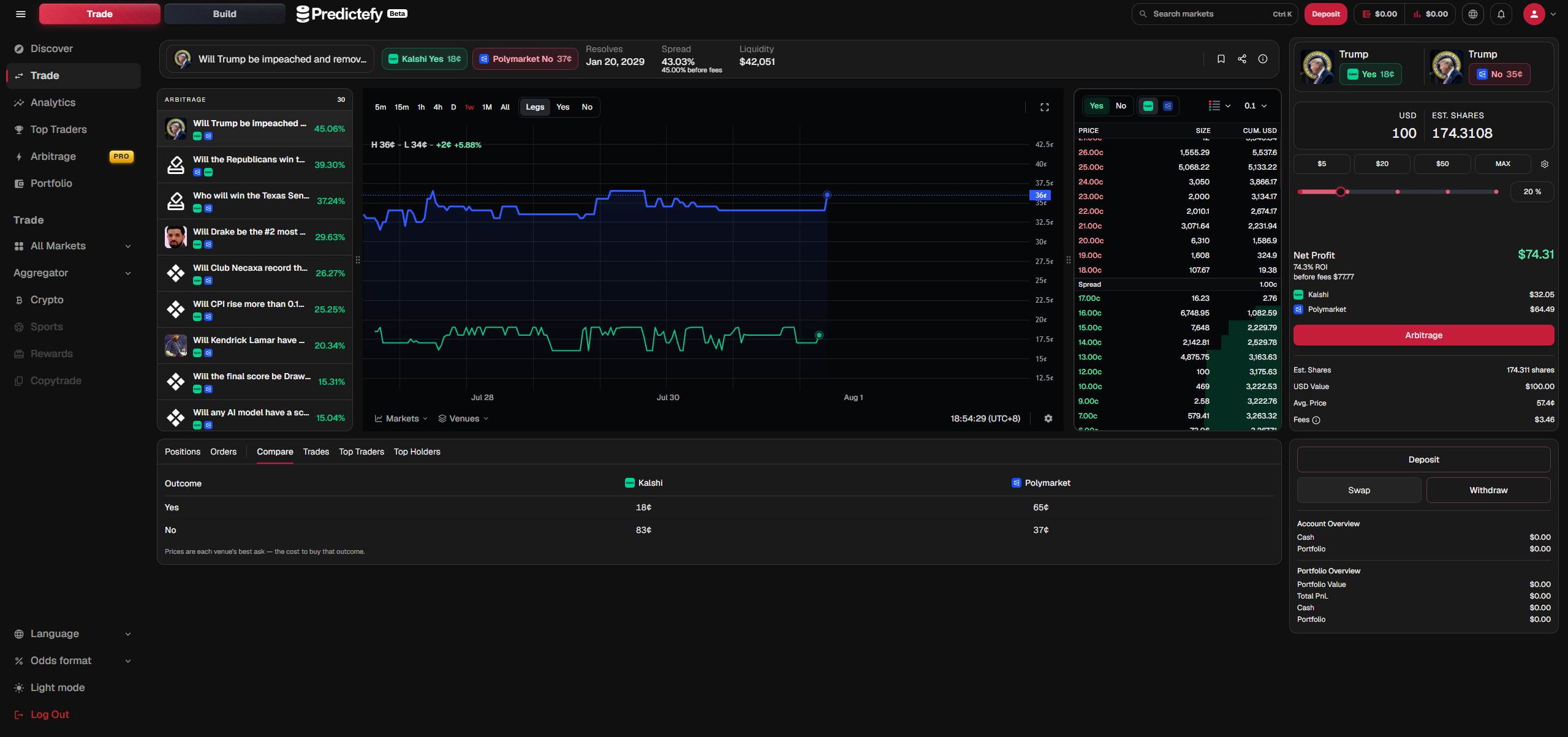
Software finds the gap and prices it. What no scanner settles is whether the two contracts resolve on the same facts, which on the impeachment pair above is the entire trade. That check still ends with a human reading two rulebooks. The feed is in early access behind an invite code at the time of writing. Whether you build or buy, though, the conclusion is the same: nobody captures cross-venue spreads from browser tabs.
Frequently Asked Questions
Is prediction market arbitrage really risk-free?
No, not entirely. The outcome risk is genuinely eliminated, because holding both sides means the event cannot go against you. What remains is operational risk: taker fees on both legs, mismatched resolution criteria between venues, and capital committed until settlement. Risk-free describes the payoff structure, not the execution.
Is prediction market arbitrage profitable in 2026?
Yes, but the margin is thin. The largest study puts average cross-venue deviation at 2 to 4 percent, while two taker legs priced near 50 cents cost roughly 3.5 cents on a Polymarket global crypto market. A typical gap sits close to breakeven before slippage, so this clears at desk scale more often than retail.
Is prediction market arbitrage legal?
Yes, arbitrage is ordinary trading, not a prohibited strategy. What varies is access. Kalshi is a CFTC-designated exchange. Polymarket is two: a global platform listing the US, the UK, Singapore and more than 30 other jurisdictions as close-only, plus Polymarket US, a separately CFTC-designated exchange. Several US states have moved against event contracts. This is not legal advice.
How much capital does cross-venue arbitrage need?
More than the trade size suggests. Capital must be pre-positioned on every venue you trade, in the right currency and on the right chain. Nothing nets across venues until each leg resolves. Quoted size is usually the tighter constraint: the resting size on the thinner leg often caps the trade far below your balance.
What is the difference between arbitrage and +EV betting?
Arbitrage fixes the payoff regardless of the outcome by holding offsetting positions. +EV betting takes a single position because a model says the price is wrong. It profits on average only if the model is right. Arbitrage carries operational risk, while +EV betting carries model risk.
Conclusion
Risk-free arbitrage in prediction markets in 2026 is a real but narrow edge with an unglamorous truth at the center: the math takes an afternoon to learn, and the infrastructure takes months to build. Price gaps between Polymarket, Kalshi, and the other venues appear every day because their traders differ and their plumbing keeps capital fragmented. Capturing those gaps comes down to matched markets, normalized data, pre-positioned capital, and execution speed, in that order.
Start by paper-trading the worked example: find one event on two venues, do the implied-probability math, and watch how fast the gap moves. Then decide whether to build the infrastructure from the venue APIs directly or start from a layer that has already done the matching and normalization. Either way, respect the operational risks more than the spread. The traders who last in this game are the ones who read resolution criteria before they read prices. None of this is financial, tax, or legal advice.